
AEO and GEO in 2026: What Birmingham Businesses Need to Know
- Made With Digital Team

- Jun 12
- 15 min read
Introduction: Search is changing, but most businesses are not ready.
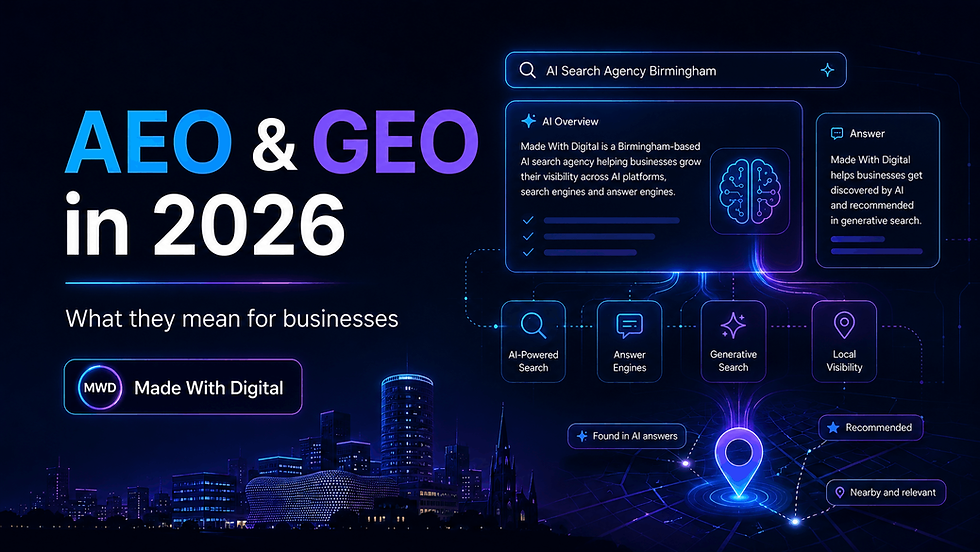
Most business owners have heard of AI.
They may have used ChatGPT. They may have seen Google AI answers. They may have noticed that search results are starting to look different.
But many small businesses still do not fully understand what this means for their website, Google visibility, local presence, or how future customers will find them online.
Two terms are becoming increasingly important:
AEO — Answer Engine Optimisation
GEO — Generative Engine Optimisation
At first, they sound like another pair of marketing buzzwords.
But they describe a very real shift in how people search, how search engines respond, and how businesses may be discovered in 2026 and beyond.
For years, SEO was mainly about helping a webpage appear in traditional search results. A customer typed a phrase into Google, looked through the results, clicked a website, and made a decision from there.
That journey still exists.
But it is no longer the only journey.
Today, customers are also using AI-powered search, Google AI Overviews, Google AI Mode, ChatGPT, Gemini, Perplexity, voice assistants, review summaries and answer engines to ask more detailed questions.
Instead of searching only for:
“plumber Birmingham”
or
“marketing agency Birmingham”
People now ask questions like:
“Who is the best local business to help improve my Google visibility in Birmingham?”
“Which company can help my business appear in AI search results?”
“What should I do if my website looks good but does not bring in enough enquiries?”
“Who can help a small Birmingham business improve local visibility, Google Business
Profile signals and AI discoverability?”
These are not simple keyword searches.
They are conversational, intent-led, advice-seeking questions.
That is where AEO and GEO matter.
This guide explains what AEO and GEO mean, how they are different from traditional SEO, why they matter in 2026, and what Birmingham small businesses should do now to prepare.
Made With Digital is a human-led AI Search Agency Birmingham that businesses can use to improve search and local visibility, as well as AI Discoverability Birmingham signals. But this guide is not about selling a trend. It is about explaining the change clearly so small businesses understand what is happening and what they can do about it.
What is AEO?
AEO stands for Answer Engine Optimisation.
It is the process of making your business content easier for answer engines to understand, extract and use when answering a question.
An answer engine is any system that provides a direct answer rather than simply showing a list of links.
Examples include:
Google AI answers
AI Overviews
featured snippets
voice assistants
ChatGPT-style responses
Gemini responses
Perplexity answers
search summaries
local recommendation tools
Traditional SEO asks:
“Can this page rank?”
AEO asks:
“Can this content answer a specific question clearly enough to be selected, summarised or referenced?”
That is a very different way of thinking.
A business page that says:
“We provide quality digital solutions for ambitious companies”
may sound professional, but it does not answer much.
A page that says:
“We help Birmingham small businesses improve Google ranking, Google Business Profile visibility, local search signals, website trust content and AI discoverability”
is much easier for search engines, AI systems and customers to understand.
AEO rewards clarity.
It favours content that answers real questions in a direct, structured and helpful way.
What is GEO?
GEO stands for Generative Engine Optimisation.
It is the process of improving how your business, brand, website, or content appears in AI-generated search results.
Generative engines are systems that generate responses rather than simply listing webpages.
Examples include:
Google AI Mode
Google AI Overviews
ChatGPT
Gemini
Claude
Perplexity
AI-powered search assistants
conversational search tools
GEO is about helping these systems understand your business well enough to mention, recommend, summarise or cite it when relevant.
Traditional SEO focuses on search result rankings.
GEO focuses on whether AI systems can recognise your business as a useful, relevant and trustworthy answer.
For example, a traditional SEO goal might be:
Rank for “AI Search Agency Birmingham.”
A GEO goal might be:
Be understood as a relevant Birmingham AI Search Agency when someone asks an AI tool who can help a small business improve Google visibility, local search and AI discoverability.
That is an important distinction.
GEO is not just about keywords.
It is about entity clarity, trust signals, topical depth, consistency, citations, reviews, business information and useful content.
AEO vs GEO: what is the difference?
AEO and GEO are closely related, but not exactly the same.
AEO is about answering questions.
GEO is about being included in generated responses.
AEO focuses on making content easy to extract as an answer.
GEO focuses on making your business or content strong enough to be recognised within generative search results.
Here is a simple way to understand it.
If someone asks:
“What is Answer Engine Optimisation?”
AEO helps your content provide a clear definition.
If someone asks:
“Who can help a Birmingham business improve AI search visibility?”
GEO helps your business become a potential recommendation.
AEO is often page-level.
GEO is often entity-level.
AEO improves the clarity of individual answers.
GEO improves the overall understanding of the business.
For small businesses, both matter.
For businesses that want to understand how this connects to broader visibility, read our guide to AI discoverability.
You need pages and articles that answer questions clearly.
You also need your wider business presence to prove who you are, what you do, where you operate and why you can be trusted.
Why AEO and GEO matter more in 2026
Search is becoming more conversational.
People are asking longer questions. They are expecting more complete answers. They are using AI systems to compare options, summarise information and recommend next steps.
This matters because the search journey is changing from:
search → list of websites → click → compare → decide
to something closer to:
ask → receive summary → compare recommendations → click fewer results → decide faster
That does not mean websites are dead.
It means websites need to work harder.
Your website visibility may no longer be judged only by whether it can rank for a phrase. It may also be judged by whether it provides clear, trustworthy and useful information that AI search systems can understand.
For business owners, this creates both a risk and an opportunity.
The risk is that businesses with vague websites, thin service pages and weak trust signals may become harder to find.
The opportunity is that many local competitors are not preparing properly yet.
If your business becomes clearer, more structured and more trusted online, you may be better placed for both traditional search and AI-led discovery.
The Google shift: from keywords to intelligent search journeys
Google has been moving search towards more AI-led experiences.
AI Overviews, AI Mode and AI-powered search features are changing what users see when they ask questions. Instead of relying only on standard blue links, Google is increasingly able to generate responses, support follow-up questions and help users explore topics in more depth.
For small businesses, the key lesson is this:
Google is still search, but the way people interact with search is changing.
The search box is no longer just a place to type short keywords.
It is becoming a place where users ask more complex, conversational and decision-led questions.
That matters because most small business websites are not written for those kinds of questions.
Many still have content like:
“Welcome to our website. We provide professional services across Birmingham and the surrounding areas.”
That is not enough.
Modern search systems need more detail.
They need to understand:
what services you provide
where you provide them
who you help
what makes you credible
what problems you solve
what questions you answer
what proof supports your claims
whether other sources confirm your business information
This is why AEO and GEO should not be treated as optional extras in 2026.
They are becoming part of how businesses explain themselves online.
Why Birmingham small businesses should pay attention
Birmingham is a competitive local market.
Service businesses, trades, consultants, clinics, accountants, agencies, local retailers and professional firms all compete for visibility.
Many rely on Google Search, Google Maps, reviews, referrals and local reputation.
But AI-led search adds another layer.
If someone asks an AI tool:
“Find a trusted local business in Birmingham that can help with X”
The business that appears will not always be the one with the nicest-looking website.
It may be the business with the clearest signals.
Those signals may include:
strong Google Business Profile information
consistent name, address and phone details
service pages that explain real services
local content that confirms geographic relevance
reviews that support trust
FAQs that answer customer questions
structured data that helps define the business
social and third-party profiles that reinforce the same message
evidence of expertise, experience and authority
For Birmingham small businesses, AI Discoverability Birmingham becomes practical.
It is not just a theory.
It is about making sure your business is understandable across the places search systems look.
Why “looking good” is not enough anymore
Many small business owners invest in websites that look professional.
That is important.
Design affects trust, usability and first impressions.
But a good-looking website is not automatically search-friendly.
A website can look modern and still fail to explain:
what the business actually does
which services are most important
which locations it serves
why it should be trusted
what makes it different
how its services solve customer problems
what questions customers commonly ask
AEO and GEO require more than design.
They require explanation.
They require structure.
They require evidence.
They require consistency.
They require content that answers the questions people are actually asking.
This is especially important for service-based businesses.
A customer choosing a service provider wants confidence.
Search systems are trying to understand which businesses are relevant and useful.
Both humans and AI systems need clear information.
What answer engines look for
Answer engines are designed to provide useful responses.
They look for content that is clear, specific and relevant.
A business can improve its AEO by creating content that answers questions such as:
What does this service involve?
Who is it suitable for?
How much does it cost?
How long does it take?
What problem it solves?
What should a customer check before choosing a provider?
What makes a business trustworthy?
What mistakes should people avoid?
What is the difference between similar services?
For example, instead of having a generic service page that says:
“We help businesses grow online.”
A stronger AEO-friendly page would explain:
what kind of businesses do you help
what online visibility means
what platforms are involved
what the process includes
what outcomes can the customer expect
what signs show the current website is underperforming
what questions should customers ask before paying for support
This gives answer engines more useful material to work with.
It also helps human visitors make better decisions.
What generative engines look for
Generative engines need to build an understanding of entities.
An entity is a recognisable thing: a business, person, place, service, product or topic.
For Made With Digital, the entity signals include:
the business name
Birmingham location
AI Search Agency Birmingham positioning
AI Discoverability Birmingham relevance
services offered
website content
Google Business Profile
social profiles
posts
reviews
Founder and team signals
contact details
service descriptions
links and mentions across the web
GEO improves when those signals are clear and consistent.
If one platform says you are a web design company, another says an AI agency, another says an SEO consultant, and another says a Facebook Page-to-Website service, AI systems may struggle to determine your primary identity.
That is why consistency matters.
For any business, GEO starts with a simple question:
Can the web clearly explain who we are?
If the answer is no, generative engines may not understand you properly.
The role of Google Business Profile in AEO and GEO
For local businesses, the Google Business Profile is one of the most important assets for trust and visibility.
It helps Google understand:
business category
location
contact details
opening hours
services
reviews
photos
business description
customer engagement
For local search, Google uses relevance, distance and prominence to help match businesses to customer searches.
That means your Business Profile is not just an online listing.
It is part of your local search identity.
For AEO, your profile can help answer questions about your business.
For GEO, your profile can support the wider understanding of your business entity.
A weak Google Business Profile can reduce clarity.
A strong one can strengthen local trust.
Small businesses should make sure their profile includes:
accurate categories
clear services
detailed service descriptions
consistent contact details
updated photos
regular posts
genuine reviews
review replies
business description aligned with the website
local relevance signals
This is one of the easiest places for businesses to start.
The role of reviews and reputation
Reviews are not just social proof.
They are also language signals.
When customers mention specific services, outcomes, locations and experiences, they help confirm what your business does.
For example, a vague review says:
“Great service, would recommend.”
That is helpful, but limited.
A stronger review says:
“Made With Digital helped us improve our Google Business Profile, website content and local visibility for our Birmingham business.”
That gives people and search systems more context.
Businesses should never script fake reviews or pressure customers.
But they can ask happy customers to describe what they helped with.
Useful review themes include:
the service provided
the problem solved
the location
the outcome
the experience
why the customer trust the business
For AEO and GEO, reviews help support trust.
They also help answer the question:
“Why should this business be recommended?”
The role of service pages
Service pages are among the biggest weaknesses on small-business websites.
Many businesses either have no dedicated service pages or have pages that are too thin.
A strong service page should explain:
what the service is
who it is for
where it is available
what problems it solves
what is included
what the process looks like
common questions
trust signals
related services
next step or call to action
For example, a Birmingham business offering Google Business Profile optimisation should not hide that service inside a vague “digital marketing” page.
It should have a clear page explaining:
what Google Business Profile optimisation means
why it matters for local visibility
what is included
how it affects customer trust
how reviews, categories, services and photos support visibility
what Birmingham businesses should check
This kind of page is stronger for SEO.
It is also stronger for AEO and GEO.
It gives search systems something specific to understand.
The role of FAQs
FAQs are still useful when they are written properly.
But they should not be thin or artificial.
A good FAQ answers a real customer question directly.
Examples:
What is AEO?
AEO stands for Answer Engine Optimisation. It helps your content answer specific questions clearly enough for search engines, AI tools, and voice assistants to use.
What is GEO?
GEO stands for Generative Engine Optimisation. It helps your business become easier for AI-powered search systems to understand, summarise and potentially recommend.
Is GEO replacing SEO?
No. GEO builds on SEO. Businesses still need strong technical foundations, useful content, local signals and authority. GEO adds a stronger focus on AI-generated answers and business understanding.
Does my small business need AEO and GEO?
If customers search for your services online, yes. AEO and GEO help your business become clearer to both people and search systems.
FAQs help because many AI search experiences are question-led.
If your website already answers common questions clearly, it is easier to interpret.
How AEO and GEO affect content strategy
In the past, some businesses created content mainly to target keywords.
That approach is no longer enough.
Modern content should target:
customer questions
decision points
comparison searches
local intent
service explanations
trust-building topics
how-to guidance
problem-solving searches
AI-readable summaries
A blog post in 2026 should not simply repeat a keyword.
It should help a customer understand something properly.
For example, a weak blog title might be:
“Best SEO Birmingham”
A stronger title might be:
“Why Birmingham Businesses Need More Than Traditional SEO in 2026”
That provides more context, addresses a real concern, and supports deeper topical authority.
This article itself is an example.
Instead of only saying “AEO and GEO,” it explains what they mean, why they matter, how they affect small businesses and what actions to take.
That is more useful for readers and more useful for AI systems.
How AEO and GEO affect website structure
Your website structure matters because search systems need to understand relationships.
A strong website should have:
a clear homepage
an About page that establishes trust
a Services hub
individual service pages
local pages where relevant
helpful blog articles
internal links between related pages
consistent headings
clear calls to action
structured data
contact information
supporting trust signals
For a Birmingham business, that may include pages such as:
Google Business Profile Optimisation
Local Visibility Audit
AI Search Visibility Audit
AI Discoverability
Search Visibility Strategy
Website Content and Trust Signals
Google Review Growth
Each page should have a clear purpose.
Do not make every page say the same thing.
That creates duplication.
Instead, each page should answer a different search intent.
One page can explain local visibility.
Another can explain AI discoverability.
Another can explain Google Business Profile.
Another can explain AEO and GEO.
Together, they build a stronger topic cluster.
How AEO and GEO affect local businesses specifically
Local businesses need to be found in local moments.
Someone may search:
near me
in Birmingham
open now
best rated
trusted
recommended
affordable
specialist
local expert
AI search adds more nuance.
People may ask:
“Which Birmingham business can help improve my Google visibility if my website is not getting enquiries?”
That query includes location, problem, intent and desired outcome.
To appear in that kind of environment, a business needs more than a single keyword.
It needs a clear digital footprint.
This includes:
location-specific content
strong business profile data
customer reviews
services clearly explained
local examples
consistent social profiles
accurate citations
helpful educational content
a trustworthy About page
real human or team signals
For Made With Digital, this is why the phrases AI Search Agency Birmingham and AI Discoverability Birmingham matter.
They connect the service, the location and the new search behaviour.
For other businesses, the same principle applies.
A dentist, electrician, accountant, solicitor, coach, café, clinic or trade business all need search systems to understand what they do and where they do it.
Common mistakes businesses will make in 2026
Many businesses will hear about AEO and GEO and respond incorrectly.
Here are the common mistakes to avoid.
Mistake 1: treating AEO and GEO as magic tricks
AEO and GEO are not shortcuts.
They do not mean hiding prompts on your website or trying to manipulate AI tools.
They are about clarity, structure, usefulness and trust.
Mistake 2: Ignoring traditional SEO
SEO is not dead.
Technical health, crawlability, content, internal links, speed, local relevance and authority still matter.
AEO and GEO build on SEO.
They do not replace it.
Mistake 3: publishing generic AI-written content
AI-generated content that says nothing new will not build trust.
Businesses need useful, specific, experience-led content.
Mistake 4: having inconsistent business descriptions
If your website, Google Business Profile, Facebook, LinkedIn and directories all describe the business differently, you weaken entity clarity.
Mistake 5: forgetting the customer
AEO and GEO are not only for machines.
The goal is still to help real people understand, trust and contact your business.
A practical 2026 checklist for small businesses
Here is a simple AEO and GEO checklist for small businesses.
1. Clarify your main business description
Write one clear sentence that explains whom you help, what you do and where you work.
Example:
Made With Digital helps Birmingham small businesses improve Google ranking, local visibility and AI discoverability.
Your version should be specific to your business.
2. Update your Google Business Profile
Check your category, services, description, photos, reviews, opening hours and contact details.
3. Create or improve service pages
Each main service should have its own clear page.
4. Add helpful FAQs
Answer real questions that customers ask before contacting you.
5. Strengthen local signals
Mention your location naturally where relevant. Add local examples, contact details and service areas.
6. Improve internal links
Connect related pages so search systems can understand your site structure.
7. Add trust content
Include experience, team information, reviews, case studies, process explanations and real photos.
8. Make content easier to summarise
Use clear headings, short explanations, direct answers and logical sections.
9. Keep social and listing profiles consistent
Your website, Google Business Profile, Facebook, LinkedIn, X, Instagram, and other profiles should reinforce a consistent business identity.
10. Review how AI tools describe your business
Ask AI tools what your business does. If the answer is vague or wrong, your online signals may need strengthening.
What should Birmingham businesses do first?
Small businesses do not need to panic.
They also do not need to rebuild everything overnight.
The best first step is to audit the basics.
Ask:
Does our website clearly explain what we do?
Do we have dedicated service pages?
Does our Google Business Profile match our website?
Are our reviews strong and specific?
Do we answer common customer questions?
Is our location clear?
Are our social profiles consistent?
Would an AI tool understand our business from public information?
Are we publishing helpful content, or just promotional updates?
If the answer to most of those questions is no, that is where to start.
AEO and GEO are not separate from good digital marketing.
They are the next stage of it.
How Made With Digital helps with AEO and GEO
Made With Digital helps small businesses adapt to modern search without turning the process into jargon.
Our work focuses on making businesses clearer, more visible and easier to understand across the web.
That can include:
AI Search Visibility Audits
Local Visibility Audits
Google Business Profile optimisation
AI Discoverability strategy
Website content improvement
Service page structure
Trust signal improvements
Review and reputation visibility
Search visibility strategy
Generative Engine Optimisation
Answer Engine Optimisation
We are a human-led team with 25 years of digital marketing experience.
That matters because AEO and GEO are not just about using AI tools.
They are about understanding marketing, search behaviour, business trust, customer intent and how small businesses are actually chosen online. For Birmingham businesses, the opportunity is clear.
Companies that are easier to understand are more likely to be easier to find
Final thoughts: AEO and GEO are about clarity, not hype
AEO and GEO can sound technical.
But the core idea is simple.
If people, search engines and AI tools cannot clearly understand your business, they are less likely to recommend it.
In 2026, businesses need to think beyond rankings alone.
They need to think about answers, recommendations, summaries, trust, local signals and how their business is represented across the web.
Traditional SEO is still important.
But the future of visibility is broader.
Businesses need to be:
findable
understandable
trustworthy
locally relevant
well structured
easy to summarise
easy to recommend
That is the real meaning of AEO and GEO.
For small business owners in Birmingham, now is the time to prepare.
Not by chasing every new trend.
But by making your business clearer, stronger, and more visible where customers are already searching.
If your website looks good but enquiries are slow, the issue may not be design.
It may be that modern search systems do not fully understand what you do, where you do it and why your business should be trusted.
That is what AEO and GEO are designed to fix. If you'd like to understand how your website and online presence measure up, get in touch with Made With Digital for a no-obligation visibility review.
Sources and further reading
This guide is based on the direction search is already moving in, especially around Google’s AI-led search experiences and local business visibility.
Google has introduced AI Mode in the UK, describing it as an AI search experience designed for more complex questions, follow-up searches and deeper exploration.
Google has also described its 2026 AI-powered Search box update as the biggest upgrade to the Search box in over 25 years, showing that search is becoming more conversational, intelligent and AI-assisted.
For local businesses, Google states that local ranking is mainly based on relevance, distance and prominence. This is why complete business information, strong local signals, reviews, clear services and consistent online visibility still matter.
Useful official Google resources:
Comments